The Mobile Core's Dynamic Future
How AI, Edge, Resilience, and NTN Rewrite Who Runs the 5G Core in 2026
6 Minute Read
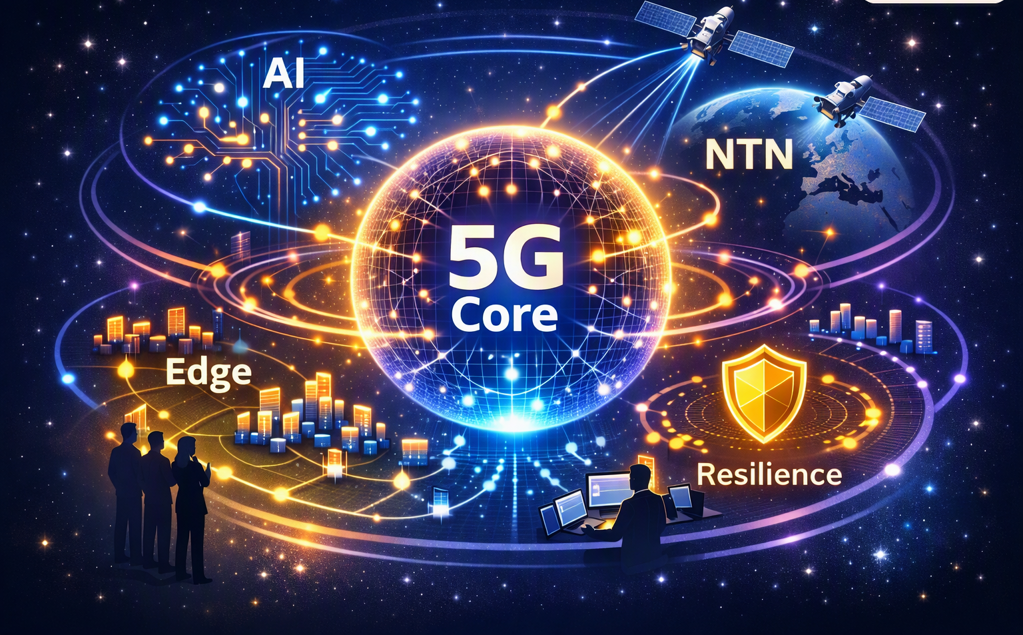
A network engineer who spent a decade writing charging rules now spends her day validating rules an AI wrote in minutes — and that quiet role change, repeated across every team, is the real story of the 5G Standalone core in 2026. As networks evolve toward 5G SA and the 5G Core (5GC), the architecture is undergoing a radical shift, but the harder shift is organizational. The core is becoming a dynamic, intelligent, and resilient platform, and operators are finding that technology alone cannot deliver it: success depends on people, processes, and the operating models that guide them. Across conversations with customers, partners, and industry leaders, 2026 looks like the pivot year — not just for AI, edge access, disaster protection, and Non-Terrestrial Networks (NTN), but for the human and operational practices required to run a cloud-native core.
The mobile core's transformation is organizational: three role transitions move today's siloed, reactive teams toward AI-native, cross-functional ones. Artificial intelligence is reshaping the 5GC in two ways: by enhancing the core itself and by introducing AI as a new class of traffic. Beneath both is a deeper change — AI changes how teams work. Generative AI compresses weeks of charging-rule creation into minutes, while agentic AI adjusts routing and scaling with less human steering, and self-healing cloud-native network functions (CNFs) reduce reactive troubleshooting. These shifts move teams from rule writers to rule validators, from troubleshooters to resilience engineers, and from siloed specialists to cross-functional automation teams. Emerging agentic interfaces such as the Model Context Protocol (MCP) and agent-to-agent (A2A) patterns raise new expectations around data literacy, model governance, and cross-domain collaboration. Operators who invest in upskilling and process redesign will get more out of AI-native cores than those who buy the tooling alone.
The traffic AI introduces is bursty, uplink-heavy, latency-sensitive, and often safety-critical — and supporting it is as much an operational challenge as a technical one. Teams have to coordinate with enterprise AI groups, manage unpredictable traffic patterns, fold edge sites into daily operations, and adopt DevOps-style observability. Distributed edge User Plane Functions (UPFs) don't just change the network; they change who operators collaborate with, how they plan capacity, and how they respond to incidents.
Edge computing keeps reshaping the core by moving intelligence closer to users and devices. Distributed UPFs and local breakout bring compute to the enterprise edge — and bring operational responsibility closer to the enterprise with it. That demands new playbooks for edge-site maintenance, shared-responsibility models between operators and enterprises, and SLAs written for latency-critical workloads. As roaming-as-a-service offerings emerge, operators will need to rethink onboarding, support, and lifecycle management, because these models reshape partnership structures and operational expectations.
Control and User Plane Separation (CUPS) — standardized in 3GPP from Release 14 and carried into the 5GC's split of the SMF (control) from the UPF (user plane) — remains a foundational enabler of flexible, edge-native designs, but its real impact is organizational. CUPS pushes operators to separate control-plane and user-plane operational teams, redesign monitoring and escalation paths, rethink capacity planning, and adopt distributed troubleshooting workflows. It is as much a process transformation as a technical one.
As networks become more vital to society, disaster protection is shifting from reactive recovery to resilience-first cultures. Cloud-native architectures enable autonomous failover, self-healing behaviors, and rapid redeployment of instances during disruptions — but resilience is a discipline, not a feature. Operators have to move from reactive firefighting to proactive resilience engineering, from manual failover to automated recovery pipelines, and from hardware redundancy to software-driven continuity. AI-driven anomaly detection only pays off when teams embrace continuous testing, chaos engineering, blameless postmortems, and cross-team visibility. Resilience is ultimately a people practice, not just a platform capability.
The core is also expanding past terrestrial boundaries as satellite-based NTNs — introduced for 5G in 3GPP Release 17 — integrate more deeply with terrestrial networks. That expansion forces operators to coordinate across satellite providers, cloud vendors, enterprise IT teams, public safety agencies, and global roaming partners, which in turn demands new governance models, new security processes, and new cross-domain operational roles. The Security Edge Protection Proxy (SEPP) and Service Communication Proxy (SCP) secure signaling across domains, but people secure the processes that make those systems work.
Automation, security, and 5G-Advanced are accelerating the need for modern operating models. Automation is progressing across Day 0, Day 1, and Day 2 operations, but it only succeeds when organizations adopt Git-based workflows, intent-based design reviews, CI/CD pipelines, and cross-functional change management. Security is expanding into data governance, certificate lifecycle management, vulnerability management, and role-based access control — all of which need clear ownership and accountability. Network slicing is becoming dynamic and on-demand, which means product teams must define slice templates, operations teams must automate lifecycle management of the slice instances (NSIs/NSSIs), and enterprise teams must coordinate requirements. 5G-Advanced (3GPP Release 18 and beyond) introduces new capabilities, but it also introduces new roles, new workflows, and new cross-domain responsibilities.
The mobile core is no longer a static backbone; it is becoming a programmable, adaptive, intelligent system. But the operators who thrive in 2026 will not be the ones with the most advanced technology. They will be the ones who invest in people, modernize processes, build resilience-first mindsets, adopt cross-functional operating models, equip teams with AI-native tools, and collaborate across terrestrial and non-terrestrial domains. Technology sets the stage; people and processes determine the outcome. The practical test for any operator reading this: pick one core domain — AI, edge, resilience, or NTN — and ask whether the roles, runbooks, and cross-team ownership behind it have changed as much as the architecture has. Where the answer is no, that is the 2026 backlog.