From Walkie-Talkies to AI-Native Response
The Strategic Modernization of Public Safety Networks
7 Minute Read
Public safety networks are the backbone of emergency response — connecting police, fire, EMS, and disaster-recovery teams in the moments where seconds matter. What began with Motorola's two-way radios has grown into a layered ecosystem of mission-critical voice, broadband data, and AI-assisted coordination. As telecom modernizes, public safety is undergoing a strategic transformation that blends the hardened reliability of land mobile radio with next-generation intelligence — and the operator's real challenge is sequencing that shift without losing the fallback that has always worked.
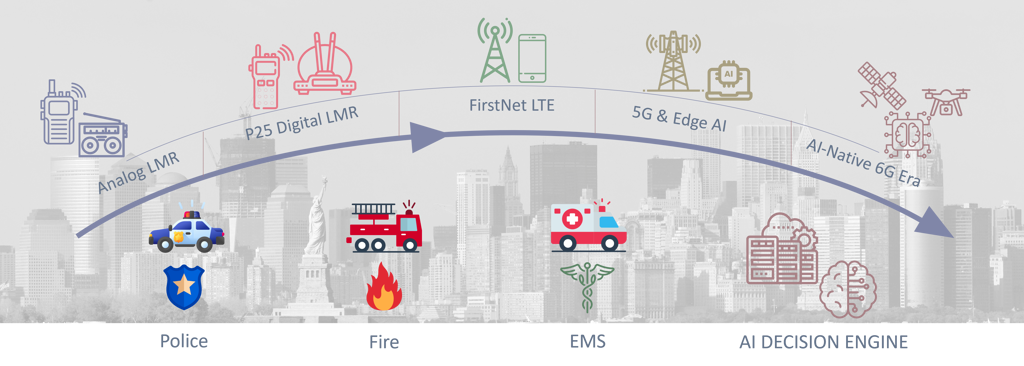
Public safety networks evolve from analog LMR through digital P25 and FirstNet LTE to 5G edge AI, heading toward an AI-native, 6G-era response platform. Public safety communications began in the 1930s, when Motorola introduced vehicular mobile radio for police patrols and laid the foundation for mission-critical voice. Those early systems matured into Land Mobile Radio (LMR) networks carrying secure analog voice across agencies. Over time, digital LMR and the TIA-102 Project 25 (P25) standard suite improved interoperability, encryption, and coverage — especially across dense urban grids and remote rural terrain. Built for rugged reliability on dedicated spectrum and hardened sites, these systems still anchor agency communications: even today, P25 LMR remains a trusted fallback during broadband outages, underscoring its enduring value when the network simply cannot go down.
FirstNet marked the pivotal shift toward broadband-powered public safety. Built on Band 14 LTE and operated under contract by one of the U.S. major operators, it delivered high-speed data that traditional LMR could not — real-time video from body-worn cameras and drones, GPS-based tracking, and multimedia coordination during crises. Critically, FirstNet provides first responders priority and preemption on the carrier network, so public safety traffic holds up when commercial cells are congested. The broader migration to LTE and 5G enables data-intensive applications and real-time situational awareness, reshaping how agencies operate in the field, and extends the standardized mission-critical services 3GPP defines — MCPTT, MCData, and MCVideo (TS 22.179, TS 23.379) — that let broadband carry the push-to-talk workloads LMR pioneered. Those same pipes support remote diagnostics, telemedicine in disaster zones, and AI-assisted triage.
Modern public safety networks now integrate AI, cloud computing, and IoT. AI workloads drive predictive analytics, anomaly detection, and automated dispatch, while edge compute near the radio access network keeps latency low for time-sensitive decisions. Cloud migration reduces dependence on fixed infrastructure, making capabilities more portable and elastic. Telemetry from IoT sensors and video feeds sharpens situational response, and scaling AI in production depends on disciplined model lifecycle management (MLOps) and hardware acceleration through GPUs and NPUs at the edge. These capabilities also enable environmental monitoring — wildfire detection, flood prediction — so agencies can act before disaster strikes, and historical incident data can be mined to optimize resource allocation and anticipate high-risk zones.
As these networks grow more complex, cybersecurity and resilience become paramount: public safety systems must withstand natural disasters, cyberattacks, and operational failures at once. Core safeguards include end-to-end encryption, multi-factor authentication, and tested backup and failover. AI-driven decisions add a governance burden of their own — model explainability for fault tracing and SLA accountability, bias mitigation across diverse geographies and user segments, and resilience against adversarial inputs and model drift. Regulatory frameworks are still evolving toward transparency, fairness, and operational trust, so agencies cannot wait for them to settle. They must also plan for coordinated attacks on digital and physical infrastructure together; cyber drills, red-teaming, and cross-agency threat-intelligence sharing are becoming table stakes rather than optional exercises.
Interoperability remains the persistent challenge, especially where legacy LMR coexists with IP-based broadband. These hybrid environments demand deliberate orchestration to keep communication seamless across radio and packet domains. P25's standardized Inter-RF Subsystem Interface (ISSI) lets disparate LMR systems connect across vendors and jurisdictions, while O-RAN Alliance interfaces push the same modular, vendor-neutral philosophy into the broadband RAN. Seamless data sharing is what makes multi-agency responses to large-scale incidents work — the difference between coordinated action and chaos. Real-time translation and transcription are also being piloted to bridge language barriers during multi-jurisdictional operations.
Next Generation 911 (NG911) is rebuilding the nation's emergency call infrastructure, moving from analog, voice-only trunks to a fully IP-based Emergency Services IP Network (ESInet) on NENA's i3 architecture. Callers can send text, photos, and video to dispatchers, who relay it to responders in real time. NG911 sharpens situational awareness and shortens response times by enabling richer, two-way exchanges between the public and emergency services. Those digital inputs also feed AI systems that can triage and prioritize calls, surface patterns, and flag anomalies — from coordinated attacks to emerging public-health threats.
Modernization still faces real hurdles. Many agencies run aging systems that are expensive to maintain and increasingly exposed to cyber threats, and upgrading demands substantial capital — pushing governments toward federal and state grants, dedicated 911 surcharges, and public-private partnerships. Just as important is skill transformation: network teams need fluency in data science, MLOps, and AI observability to run and evolve these systems. Looking ahead, as 6G research advances, public safety is shifting from AI-enhanced to AI-native architectures, where intelligence is designed into the network rather than bolted on. Emerging capabilities — autonomous mobility coordination, immersive AR/VR for incident command, drone-assisted search and rescue — will reshape response, and standardized agentic frameworks and open APIs will be the connective tissue that makes them interoperable rather than one-off pilots.
Training has to evolve with the architecture: ethical AI design, model auditing, and cross-disciplinary collaboration belong in the curriculum, not just vendor tooling. Agencies will need to recruit beyond telecom — from data science, behavioral psychology, and urban planning — to build response systems that are holistic rather than narrowly technical.
Public safety networks are no longer just about voice — they're about vision. From Motorola's analog radios to FirstNet's LTE backbone and AI-powered edge intelligence, the arc mirrors telecom's broader shift toward openness, automation, and adaptive service delivery. For operators and agencies alike, the work is to treat modernization as a strategic program, not a procurement event — one that demands architectural foresight, operational discipline, and ecosystem collaboration. The practical first move is to name the target architecture and the fallback posture explicitly: decide which workloads ride broadband mission-critical services, which stay on P25 LMR, and what governance gate every AI-driven decision must clear before it touches a live incident. Modernization is not a one-time upgrade; it is a continuous evolution toward smarter, safer, more connected communities.